
Voigtlander 15/4.5 II welded to cojones' stealthified (i.e. electrical-taped) Leica M8
Nikon D90, AFS 105/2.8 VR Micro and diffused SB900
For a while, the Voigtlander screwmount 15/4.5 (21mm equiv.) used to be the widest lens you could get for the M mount - until they brought out the insane 12/5.6, which is so wide you get your knuckles in the photo by gripping the camera normally. It lacked rangefinder coupling - not a big deal when the depth of field scale at f22 stretches 3/4 the way around the lens barrel, but the focus ring only moves 1/4 turn - but for close in work, estimating distances could be a little hit and miss. So Voigtlander made us all happy and released a proper M-mount version earlier this year. I've been shooting with one since launch day (serial # 36!) and couldn't be happier.
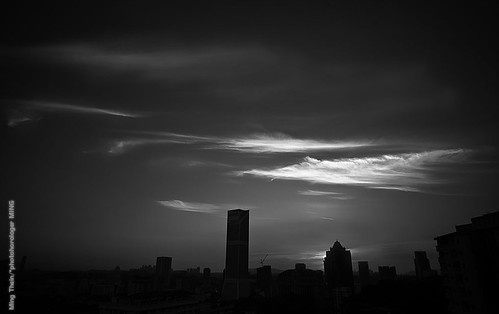
Sunset wisps, Kuala Lumpur
Leica M8, Voigtlander 15/4.5 II
Optical performance


There is really very little to say in this section that is other than good. Designing a wideangle lens for a mirrorless system is significantly easier than for an SLR; you don't have to make a telecentric design, so you can use fewer elements and make the whole optical formula symmetrical, or near to it. It's even easier if the maximum aperture is just f4.5 - not fast by anybody's standards. Fortunately the lens plays nice with lower shutter speeds, as it's so wide you have to be shaking quite a bit for motion blur to be visible in the final image. You can easily get sharp images handheld down to 1/10s.
The image is sharp all over, even in the corners, from maximum aperture to around f16, where diffraction starts taking over (on the M8 at least). Stopping down does not increase sharpness; it's already pretty much maxed out at f4.5, which is not to say it's a mediocre performer - far from it. In fact, on a per-pixel basis, I'd say it's about as sharp as the Leica 35/2 Summicron-M ASPH - which means it sits right up there on my list of sharpest lenses alongside other greats such as the 50/1.4 Summilux-M ASPH (a good copy), the Nikon AFS 300/2.8 VRII N, and the Nikon PC 85/2.5 Tilt-Shift Micro.
I don't see any chromatic aberration.
Contrast is excellent. Look at the shot below: the dark areas were very nearly pure black. Impressive, considering the sky was fairly overcast.
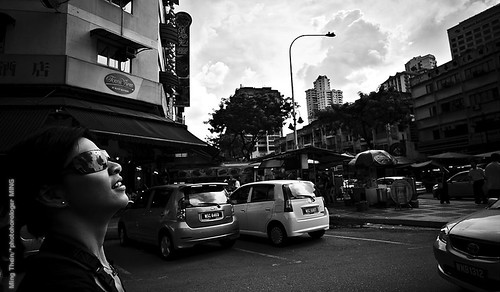
Enjoying glimpses of the sun, Kuala Lumpur
Leica M8, Voigtlander 15/4.5 II
The one area where stopping down does improve things is if you don't like vignetting: the 15/4.5 II vignettes like crazy wide open, perhaps a stop and a half or so on the M8. You can easily fix this if you're shooting RAW and using Photoshop, of course. Personally, I like it; it adds to the look and feel of the image. I'm guilty of even adding more sometimes - both to images shot with this lens, and more clinical lenses like the 35 'cron and 50 'lux.
It's difficult to comment on color transmission because I don't have a 52mm UVIR filter to go on the front, and we all know how responsive the M8 is to wavelengths we can't see. But in a quick and dirty comparison, color rendition is similar to the 35/2 Summicron-M ASPH without a UVIR filter - which suggests similar optical transmission properties.
Let's not bother talking about bokeh because there isn't any with a lens this wide and slow.
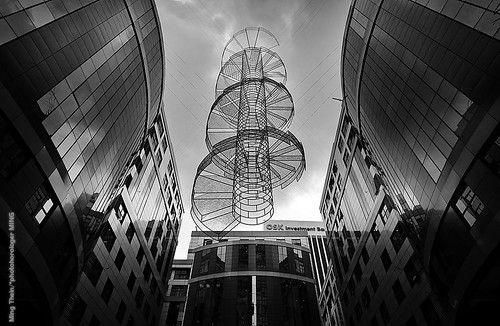
Spiral I, Kuala Lumpur
Leica M8, Voigtlander 15/4.5 II
Build quality and tactility
I must be one of the few photographers who puts an inordinate amount of importance on the way a lens handles: I like things that feel like vintage instruments, rather than melted plastic superblobs which have billions of buttons that do different things depending on which mode you're in, and which other button you've held down. Leica lenses feel amazing (at least those ones that aren't defective!). They're very smooth and precise without having any slop or backlash. And the weight adds to that feeling of solidity. Zeiss is pretty close, but they use more aluminum so they don't feel quite as solid.
Voigtlander is somewhat variable - the 50/1.5 Nokton Aspherical I also have is both light yet reasonably solid and precise at the same time, but the focusing ring has some backlash and drag that makes it easy to shift slightly off the critical point of focus. On the other hand, if the 15/4.5 II had the Leica badge on the front, I don't think I'd have expressed any disappointment at the build quality. It's nicely made, precise, without slop, and the aperture stops have a nice positive click to them. The built in hood is to protect both the front element and stop you from sticking your fingers into the frame (admittedly, I've done that a couple of times when not paying attention - you really need to use an external finder, but I find them inconvenient so I don't bother and just guesstimate the frame coverage). If I was to nitpick, the only place where the build quality lags a little is the lack of beveling on the ring edges: look at a Leica lens and notice how focusing and aperture rings are beveled.
But I digress. Let's just say that for the money, in fact, any money, it's a little jewel.
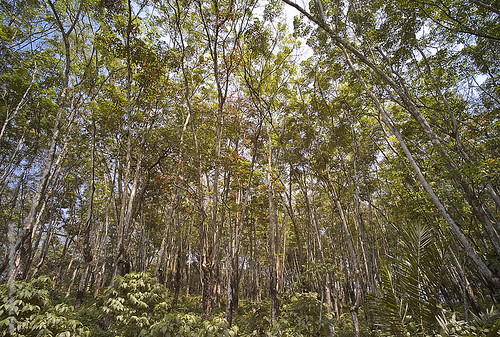
Trying to see the forest for the trees (on the full size image, I can make out individual leaves in the corners. Sharp enough for you? It is for me. And that was shot wide open...)
Leica M8, Voigtlander 15/4.5 II

Spiral II, Kuala Lumpur
Leica M8, Voigtlander 15/4.5 II
Conclusion
At US$500 or so, and considering the target audience of Leica M shooters, this lens is not only a bargain, but unique: the only similar focal length Leica has is in the 16-18-21 Tri-Elmar, and that's horribly expensive and huge. It's also not as sharp. The Voigtlander 15/4.5 II, on the other hand, is so small that you could conceivably lose it in a large pocket. It feels great to use. And the optics are fantastic.
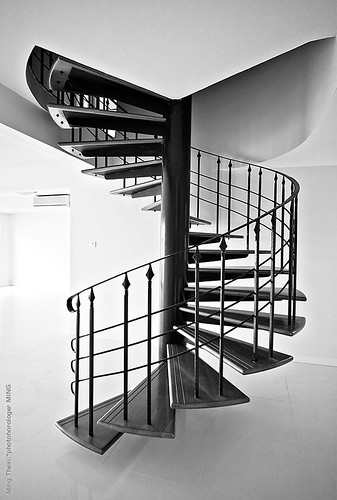
Spiral III, Kuala Lumpur
Leica M8, Voigtlander 15/4.5 II
Above all of that, though, I love the way this lens draws. I can't put my finger on it. It's contrasty, sharp, and vignettes to produce what I always think of as that classic 'rangefinder look'. I loved the 24mm length on my D3, but sometimes wanted wider. At 21 equivalent, the 15/4.5 II is nearly perfect. Now if only it could be a stop faster so I could use it at night and indoors. It's also great for fast shooting: use the depth of field scales to prefocus, aim in vaguely the right direction (the huge FOV takes care of the rest) and bang away.
Recommended? Definitely. Do you need the finder too? I don't know. Personally I don't bother, since RF framing is so loose anyway and this is a zone-focus-shoot-from-the-hip lens anyway. So, stop wasting time and go buy one. Then make pictures. Done.
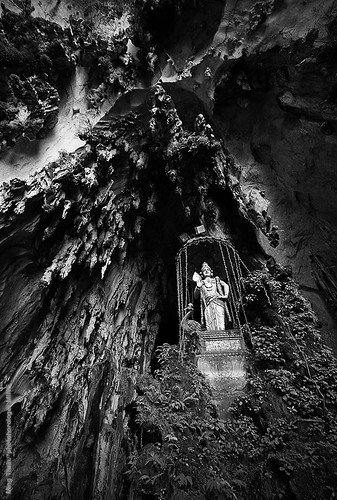
Cave god, Batu Caves, Kuala Lumpur
Leica M8, Voigtlander 15/4.5 II


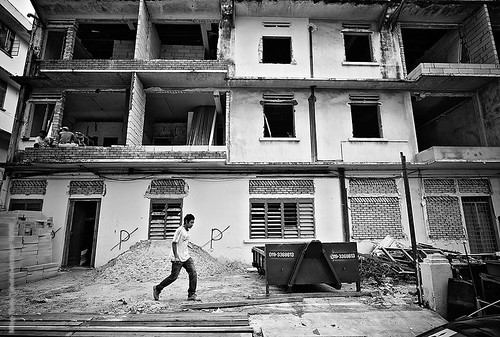


 Posts
Posts


