Showing posts with label 50. Show all posts

Friday, July 17, 2009

off to a desert island for a few days...


...so I leave you with two images, from the same perspective, but just a slight shift in focus:


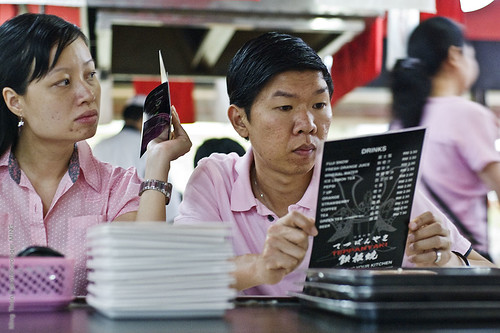
Father and daughter I, Kuala Lumpur
Leica M8, 50/1.4 Summilux-M ASPH

Father and daughter II, Kuala Lumpur
Leica M8, 50/1.4 Summilux-M ASPH


In this game, it's all about perspectives. And I got that Canon IXUS 780 IS yesterday. First impressions are favorable indeed. More when I return. Have a good weekend!

Monday, July 13, 2009

family


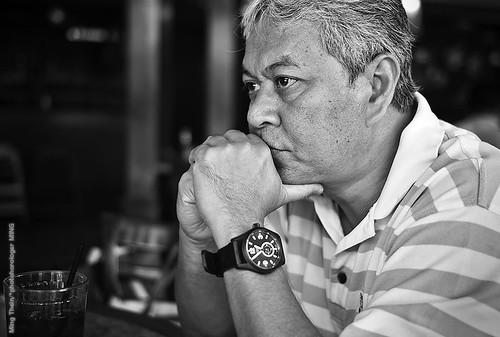
There's a certain something to portraits shot with Leica glass that I can't put my finger on.

Contemplative
Leica M8, 35/2 Summicron-M ASPH

Untitled
Leica M8, 35/2 Summicron-M ASPH


Sultry
Leica M8, 50/1.4 Summilux-M ASPH


Tuesday, July 7, 2009

equipment musings

The recent headache with the broken 50 lux and subsequent hassle dealing with distributors has made me seriously rethink how far it's worth going in pursuit of image quality.

Yes, the 50 lux - at least a good one - is quite possibly the best lens I've ever used, offering the isolation and sharpness of a good telephoto at a normal-ish field of view. The comparable Voigtlander 50/1.5 Nokton ASPH is pretty good too, considering it's 1/10th the price - and similarly for the Nikon AFS 50/1.4 G. The 50 lux is about the same price as the rare 58/1.2 Noct-Nikkor, if you can find one, that is. Is it ten times as good as the Voigtlander, or the Nikon AFS 50/1.4? Probably not.

These days, with Photoshop, almost all of the common lens defects are correctable: lateral CA can be removed, contrast can be increased, distortion can be straightened out...but you can't put back field sharpness, or edge definition.

Is an M8/35 summicron ASPH (RRP $7,000 or thereabouts) seven times better than a D90/AFS 35/1.8? (RRP <$1,000)? Probably not. I know for sure the D90 can focus better than I can when light gets low, and I'm happy using ISO 3200, but I'd call the limit 1250 on the M8. And the shutter has less vibration, too, so the whole "rangefinders-have-softer-shutters-giving-you-another-stop-or-two" argument is hokey.

For the price of one 50 lux and M8 body, assuming, you like the best primes, you could also have:

-A Nikon D700, Zeiss 35/2, Zeiss 50/1.4, and Zeiss 85/1.4
-A Canon 5DII, 35/1.4 L, 85/1.2 L, and maybe 24/1.4 L if you're willing to buy used
-A Pentax K-7D and all of the Limited primes, with change to spare

Would the image quality be significantly worse? If you were sniffing pixels and printing massive enlargements, maybe. Would the average joe be able to tell? No. It would also take a skilled photographer and post-processor to wring the most out of each combination. The D700 would win hands down on dynamic range, but suffer because of manual focus. The 5DII could deliver the best resolution, but would be sensitive to sloppy shooting technique because of the pixel density, and require careful AF point selection - half the time when lenses are soft, it's because the camera has picked the wrong thing to focus on. Case in point: the D90's AF system MUST be used in single point to focus accurately with the AFS 35/1.8 DX wide open. And for the most part, the Pentax is an unknown quantity right now.

I also think that the majority of people do not consider the importance of after-sales support when they buy into a system. For instance, Nikon here is excellent - warranty repairs for pros are handled within a few days to a week at most, and loan equipment is plentiful. I sent in my D3 once (bizzarely, the lens release button fell off) and got a D3x back while it was being repaired. I sent in a D2H and requested a D2xs to try, which I got too. Canon doesn't seem to distinguish between professionals and Ixus repairs, but they do seem to have the volume and facilities, so one would assume reasonable fast turnarounds.

Leica on the other hand...has no repair facility here. Nada. None. Zip. The closest is Singapore, and even then, repairs take at least a month. Needless to say there is also no loan equipment to be had. And if the repair is complicated, say goodbye to your equipment while it goes on an extended Bavarian holiday - anywhere up to three MONTHS, I'm told.

Back to the crux of the matter: is it worth it? Sometimes it's useful to take a step back and just check one hasn't gone insane with equipment lust. And the honest answer is I really don't know anymore.

Monday, July 6, 2009

the 50 summilux update, part two

After an entire morning and afternoon of telephone calls, I have determined that:

1. The best the distributor/ dealer here is willing to do is refund the cost of the lens, less credit card fees. They can't get another lens.

2. Leica Germany said to send it back; that'll take a few months.

3. I can buy the last remaining lens in the country, but then I'd be about $150 out of pocket because of said credit card fees and because it's at a different dealer with worse pricing. And that might turn out to be a dud too, in which case I'm seriously SOL. Maybe I'll just buy Zeiss glass instead.

However, the most disappointing thing is the amount of cajoling and weight-throwing required to get to even square one with the local distributor. It seems to me that despite having a customer who has both media influence and is willing to buy another identical one even after all the crap that he's gone through so far, they would still rather wash their hands off the problem as soon as possible. Excuse me? I guess that's why they don't sell very many of them, then. Leica have said it's the only time they've ever heard of this problem. Well, one should damn well hope they'd be doing something to investigate it, right? I would if it were my company.

Maybe I am an idiot. Maybe it's unreasonable to buy two very expensive lenses and expect that they perform the same way. Maybe it's normal for people not to take responsibility for their jobs. Oh wait, I guess that's why we landed up in this recession in the first place.

Frankly right now I'm so disillusioned with the whole thing (and deeply concerned that if something should go wrong with any of the other Leica equipment, I'm seriously screwed) that I'm wondering if I shouldn't just quit and live off a diet of point and shoots and cameraphones or something. Sigh. I look at the M8 and don't even want to pick it up to shoot because it makes me a) angry b) scared that I'll break it if I so much as look at it funny, or heaven forbid, use it to take photos.

Sunday, July 5, 2009

Goa: four tenuously related images


I recently attended a wedding in Goa. Being an Indian wedding, it was an insanely extravagant affair over several days. Needless to say, the photographic opportunities were manifold, especially for a person who's never observed the elaborateness of the whole thing before.

I leave you with a story in four images, all shot with the Leica M8 and 50/1.4 Summilux-M ASPH (the black working one, that is.)


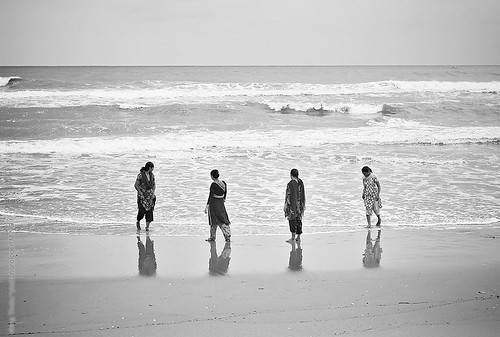
Location, location, location: the beach
Leica M8, 50/1.4 Summilux-M ASPH


Enjoyment before the wedding
Leica M8, 50/1.4 Summilux-M ASPH


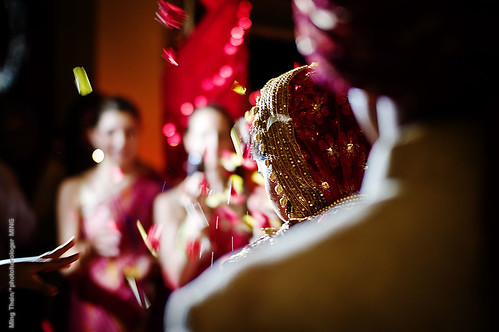
The anticipation
Leica M8, 50/1.4 Summilux-M ASPH


Celebration
Leica M8, 50/1.4 Summilux-M ASPH

Saturday, July 4, 2009

the 50 summilux tale of woe update


Being constrained to f2 and smaller is bad enough, considering the price differential between a Summicron f2 and a Summilux f1.4 is times two - and around US$2000. Nevertheless, a lens is better than no lens, however small the aperture might be. I was out shooting with the busted Lux yesterday morning because the light was awesome, and I don't have another 50 - I had to sell them all to fund the Lux.

Long story short, it not only has a busted aperture diaphragm, but it seems the optics of this lens were assembled on a Friday just before biergarten time, too. It isn't at all like the black one Fuzzbucket has. It's soft wide open, draws like the Voigtlander 50/1.5 Nokton (which isn't a bad thing, but there's a reason we're paying ten times the price for this lens) and suffers from a whole host of optical ailments. What you're looking at are 100% crops converted from M8 DNG files via ACR.


1. Corner softness - well, make it more like at close distances, only the center zone is sharp. And this on an M8's 1.3 crop sensor, at f2. The black lens is sharp all the way out to the corners, even at f1.4. Point of focus was the row of fountain jets in middle frame. You'd expect them to be sharp, considering they were pretty much perpendicular to the camera and far away, right? No. It's fine in the middle - and the fountain droplets are nice and sharp (left crop, at 100%) - but what the hell is going on in the right hand side of the frame? There's nothing sharp there at all! Just a spherically distorted mess.


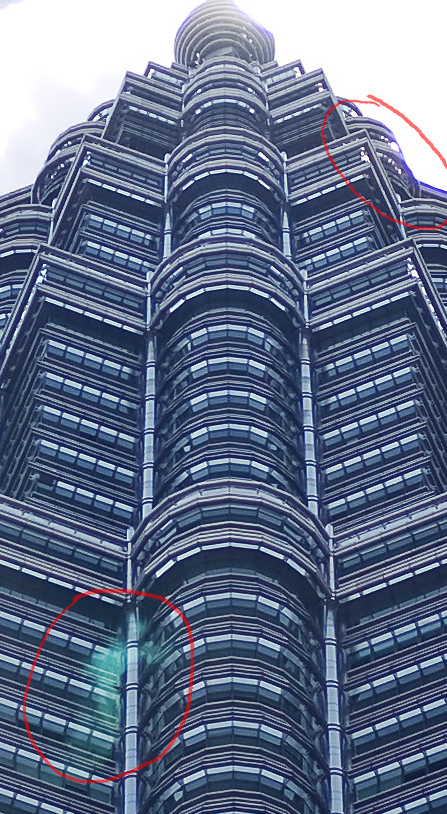
2. Chromatic aberration. WHAT?! It's an apochromatic lens, for crying out loud. This should be optically impossible. But yet, here it is. And what on earth is that greenish blob in the foreground? It doesn't look like any known sensor artefacts. I'd say it's something funny going on inside the lens itself.


3. Veiling flare. Contrast is just plain low, and the edges of things aren't nicely 'sliced out' from the background in the way the black 50 lux does.

First, the good 50 Lux: even at longer distances, the subject is almost a cutout against the background.

Once again: nothing is particularly sharp, nor have I front or backfocused it - look at the ground. And the shot was at 1/2000s, so there's no way it could have been camera shake. Point of focus on the kid's tshirt. Verdict? Soft. Just plain old soft, and low contrast, too. (This result only obtained after heavy curve adjustment). The subject was even closer than the woman with the bottle, so you'd expect more bokeh/ separation, right? I don't see it. I also don't see the fine microcontrast structure evident in the first shot. Both were shot under similar conditions - late morning, overcast but bright sky, near the equator. Should have produced similar results. They were processed the same way. But to my eye, the first looks Leica-like; the second looks like it came out of a cheap point and shoot. Simply unacceptable.


The distributor here - Schmidt Marketing - has said categorically that there are no lenses in the country with which to replace this one, so the only option is to send it to Singapore or Germany for an extended service. This is simply unacceptable - for a $4k lens to effectively arrive broken, and then tell me it's going to take three months to fix? Hello, quality control? If this were Nikon, I'd have either swapped it out straight away (likely, given the volumes they produce - but okay, we'll let Leica off the hook here) - or better still, been taken care of well by NPS and either had it fixed on the spot, or been given a replacement loaner and told to come back in a couple of days.

In any case, I'm going to call Leica Germany first thing Monday and see if their much vaunted customer service lives up to reputation. The mark of a good company is not just the quality of the products it produces when things go right, but how it deals with it when they go wrong. In all fairness, QC glitches are to be expected when dealing with what is effectively a handmade product, but this doesn't mean the customer should have to sit around with a busted lens for a few months while the company gets its act together.

Thursday, July 2, 2009

50 summilux woes

Fuzzbucket and I both recently purchased Leica 50/1.4 Summilux-M ASPH lenses, new, from our local authorized dealer. But what a different experience. Whereas the black one is functioning perfectly, the silver one has developed an aperture hiccup: first the ring was too loose and refusing to lock at any position and now one of the aperture blades is sticky - it doesn't open smoothly to f1.4 without some effort and twisting the aperture ring just the right way. I'm told by the local agent - Schmidt - that it's a 2 month German holiday to fix. Excuse me? On a US$4,000 lens, which was bought just four days ago, and hasn't even been properly shot with yet? The least you could do would be swap it for a new one - oh wait, there aren't any in stock. Hmm.

So much for German quality control.

To quote the Queen: "We are not amused."

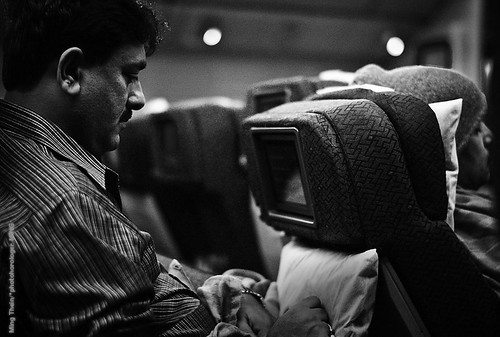
the economy class nightmare

The Economy Class Nightmare, somewhere over the Andaman Sea, Malaysian Airlines
Leica M8, 50/1.4 Summilux-M ASPH

I hate traveling. Not because I'm a xenophobe but because it's routine to be crammed into a pressurized metal tube for twelve hours with so little personal space that crossing your legs might be constituted as an act of war. And the amount of moisture in the air might as well be zero, because my skin is like sandpaper by the time I arrive. I'm sure the cabin designers hold surveys to find out just how little space a human being is willing to pay to be crammed into before they start feeling claustrophobic and irritable, or worse still, demanding their money back. I flew 108 times in 2006. I woke up in not my own bed at least three times more often than I woke up in my own. Suffice to say, while you do get some decent (though rare) opportunities from a window seat, most of the time the window is so scratched and horrible that you might as well have been shooting with a pinhole.

To make this post remotely photography related, airplanes these days are so tight and poorly lit that a) I shot this from three seats and an aisle away with a 50mm, and b) it needed 1/30th at ISO 2500 f1.4.

polarization

I'm a big fan of Ken Rockwell. His work is pretty good, but most importantly he has a big bucket of common sense that most photographers lack. Horses for courses. That kind of thing. The equipment emphasis being out of the way once the camera stops being the limitation, and you do. As we've seen from DXO, these days, almost every photographer is the limitation. Problem is, saying things like the D40 is the best camera ever made will dramatically polarize opinions and tend to get you roasted to a crisp on your average camera forum. (Note: CAMERA forum. It is NOT the same as a PHOTOGRAPHY forum). It requires a step back to see where he's coming from.

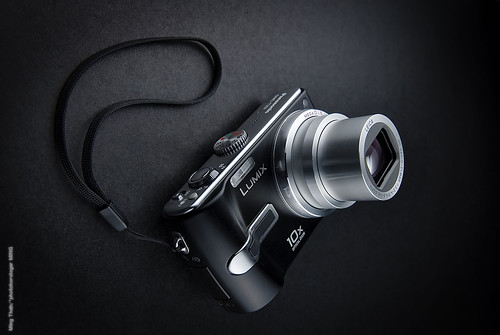
Let's take the Panasonic TZ3, which is in my experience of close to 10,000 frames, an excellent camera.

Panasonic Lumix TZ3
Nikon D200, AFS 17-55/2.8 DX, two speedlights and a diffuser

But it's a point and shoot! Cry one foul already. Even worse, it's from 2007, it's not that pocketable, has zero manual controls, and a 10x lens. Surely that can't be good for the optics.

Well, I don't know. Judge for yourself. I'd say it's a pretty damn good photojournalism camera because it's a) unobtrusive and stealthy b) gives you the reach when you need it c) goes unnoticed and d) pretty fast for a compact.

Old bunnies, London
Panasonic TZ3

I actually shot an entire assignment with it once, but for the benefit of the client left a D2H and large lens slung over one shoulder. I was having much more fun with the TZ3 though:

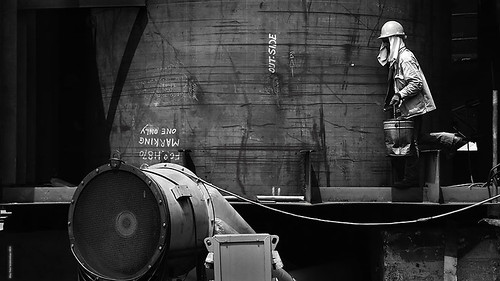
Bucket Man, Singapore
Panasonic TZ3

And it's a pretty good camera to have in your glovebox when you're driving around without the intention of going on a proper photo trip.

Mist, Bukit Tinggi, Malaysia
Panasonic TZ3

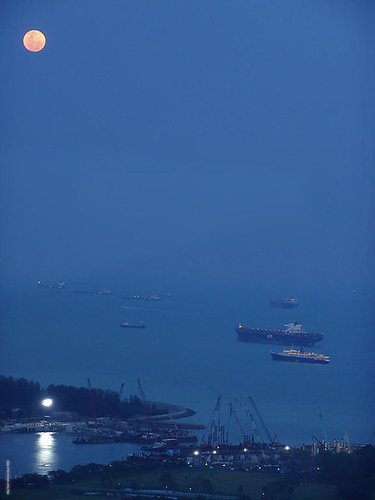
Or when you get stuck in the office late at night.

Moon and Ships, Singapore
Panasonic TZ3

With a little creativity in your choice of strobe triggers, you can even use it for studio work because it focuses nice and close across the entire range, letting you change perspectives nicely.


Nikon D3
Panasonic TZ3, single SB800 in SU4 mode

This camera has guts.

The unwanted parts of the chicken, Petaling Street Market, Kuala Lumpur
Panasonic TZ3

Yet, no self-respecting amateur would be seen using one, because it's not a big black heavy thing with a drainpipe dangling off the front that screams 'LOOK AT ME, I'M COMPENSATING!'. No. But I suspect it's the kind of thing Ken Rockwell would like because it's easy to use, and doesn't get in the way of you trying to see the shot. Not with that nice big 3" LCD, anyway. And you have everything from a 25mm to a 280mm (HFOV) with you in your pocket. Try doing that with a FF DSLR, and I guarantee you that it'll be left in the hotel after day one - so what's the use of buying something that either a) you need to read the manual every time you want to use; b) leaves you so poor you can't afford to go anywhere to make interesting pictures with it; c) makes your subjects react like hostages, or worse still, all of the above.

Back to Ken. The D40 is like the TZ3, in many ways. It's small, unobtrusive, responsive, and can deliver incredible images in the right hands: remember, photography is all about the composition, not the gear. And better than the TZ3, you can actually shoot with it when the sun goes down and not have images that look like a bowl of jellybeans because of the noise.

I leave you with two images. Naturally, shot with a D40 and a nice prime lens.

The infectious pink Singaporeanness of it all
Nikon D40, AFD 50/1.4

Sunset over Hat Yai
Nikon D40, AFD 50/1.4


Tuesday, June 30, 2009

founder: Cojones

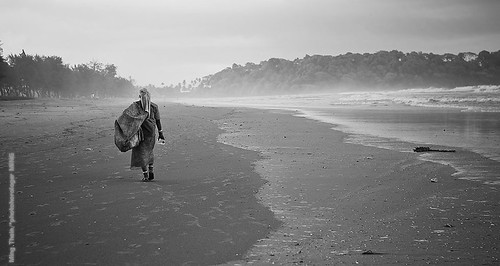
hommage a Salgado, Canacona, Goa
Leica M8, 50/1.4 Summilux-M ASPH


Cojones is a photojournalist and macrophotographer. He is technically masochistic and prefers a challenge, and has developed a recent allergy to color since discovering Leica. He learned photography by the consequences of experimentation and statistics of large numbers of frames, and bows in deference to the technical skill of Adams, the timing (but not technical ability) of HCB, the aesthetics of Salgado, and the huevos of Majoli. He is not particularly hard on his equipment but has laid more cameras to rest than the average person has had sexual partners. Film is by no means foreign - there is more Provia in his fridge than food - but does not offer the per-image flexibility of a good raw file, and for Cojones, the new darkroom reeks not of chemicals but of Photoshop and a Wacom.